Here are three iconic vintage keyboard from my collection.
First a 1960’s Hohner D6 Clavinet.
The Clavinet is an electrically amplified clavichord invented by Ernst Zacharias and manufactured by the Hohner company of Trossingen, West Germany, from 1964 to 1982. The instrument produces sounds by a rubber pad striking a point on a tensioned string, and was designed to resemble the Renaissance-era clavichord.
Although originally intended for home use, the Clavinet became popular on stage, and could be used to create electric guitar sounds on a keyboard. It is strongly associated with Stevie Wonder, who used the instrument extensively, particularly on his 1972 hit “Superstition”, and was regularly featured in rock, funk and reggae music throughout the 1960s and 1970s. Modern digital keyboards can emulate the Clavinet sound, but there is also a grass-roots industry of repairers who continue to maintain the instrument.
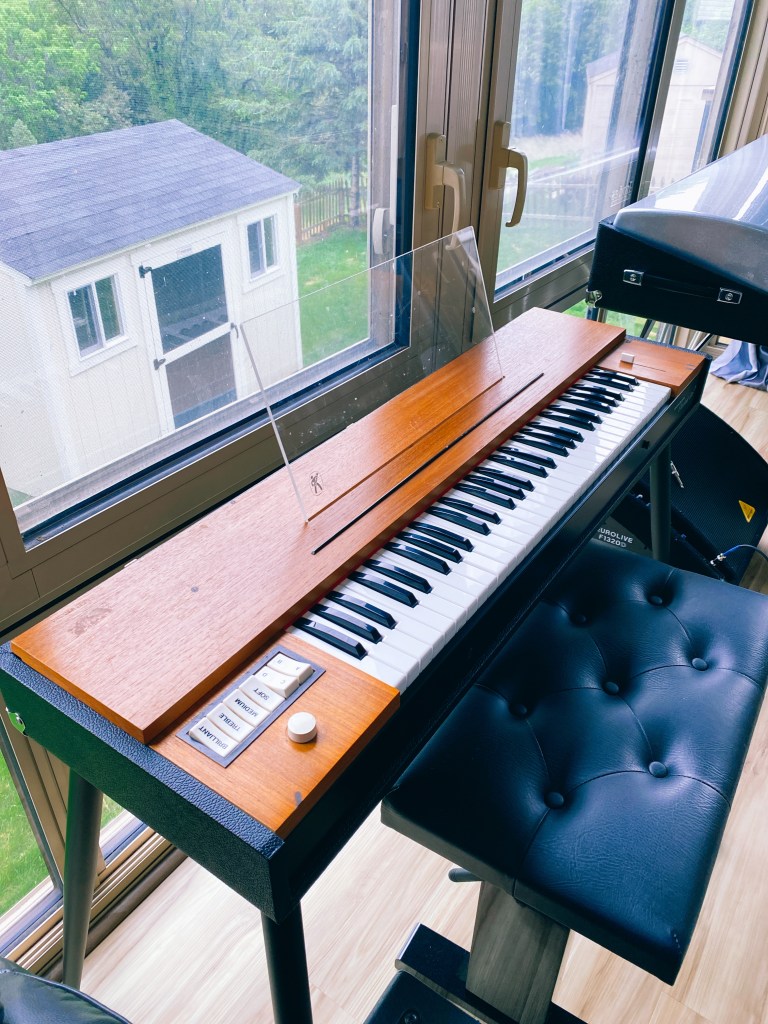
Next is the Rhodes 88 Mark I Electric Piano.
The Rhodes piano (also known as the Fender Rhodes piano) is an electric piano invented by Harold Rhodes, which became popular in the 1970s. Like a conventional piano, the Rhodes generates sound with keys and hammers, but instead of strings, the hammers strike thin metal tines, which vibrate next to an electromagnetic pickup. The signal is then sent through a cable to an external keyboard amplifier and speaker.
The instrument evolved from Rhodes’s attempt to manufacture pianos while teaching recovering soldiers during World War II. Development continued after the war and into the following decade. In 1959, Fender began marketing the Piano Bass, a cut-down version; the full-size instrument did not appear until after Fender’s sale to CBS in 1965. CBS oversaw mass production of the Rhodes piano in the 1970s, and it was used extensively through the decade, particularly in jazz, pop, and soul music. It was less used in the 1980s because of competition with polyphonic and digital synthesizers such as the Yamaha DX7 and an inconsistent quality control caused by cost-cutting.
In 1987, the company was sold to Roland, which manufactured digital versions of the instrument without authorization from Harold Rhodes. In the 1990s, the instrument experienced a resurgence in popularity, resulting in Rhodes re-obtaining the rights to the piano in 1997. Although Harold Rhodes died in 2000, the Rhodes piano has since been reissued, and his teaching methods are still in use.

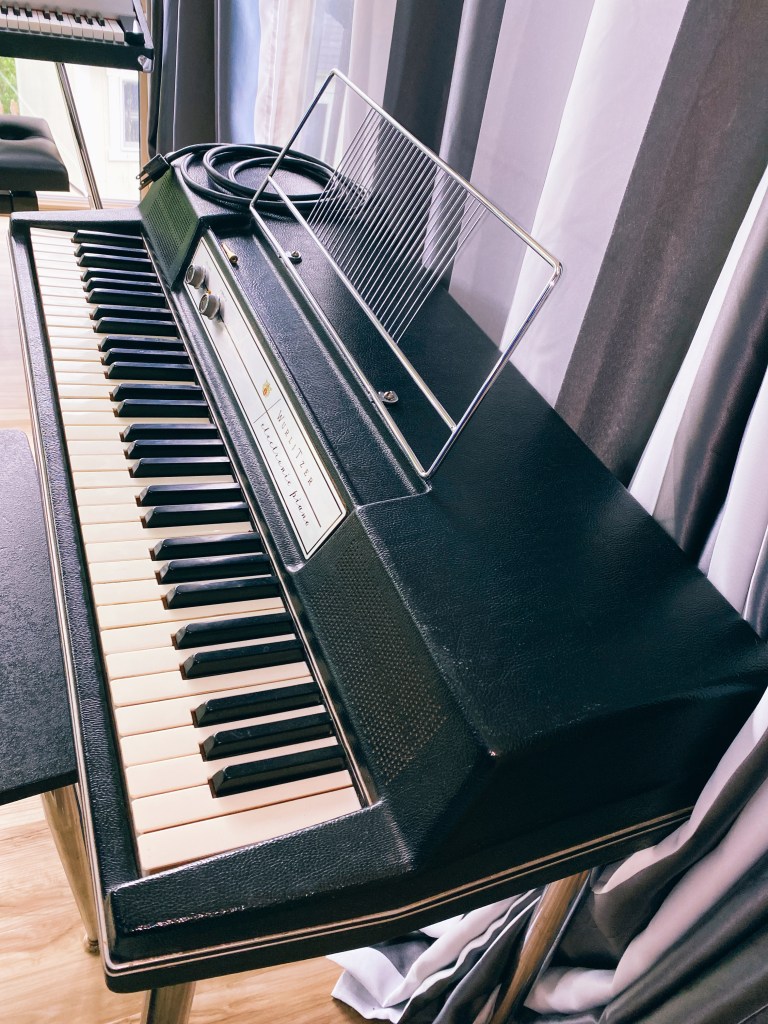
Finally, the Wurlitzer 200 Electric Piano.
The Wurlitzer electronic piano is an electric piano manufactured and marketed by Wurlitzer from the mid-1950s to mid-1980s. Sound is generated by striking a metal reed with a hammer, which induces an electric current in a pickup. It is conceptually similar to the Rhodes piano, though the sound is different.
The instrument was invented by Benjamin Miessner, who had worked on various types of electric pianos since the early 1930s. The first Wurlitzer was manufactured in 1954, and production continued until 1983. Originally, the piano was designed to be used in the classroom, and several dedicated teacher and student instruments were manufactured. However, it was adapted for more conventional live performances, including stage models with attachable legs and console models with built-in frames. The stage instrument was used by several popular artists, including Ray Charles, Joe Zawinul and Supertramp. Several electronic keyboards include an emulation of the Wurlitzer.
As the Wurlitzer is an electromechanical instrument, it can need occasional maintenance, such as re-tuning and replacing broken reeds. However, the action and performance of the instrument has meant it is stable enough to be used for years.
 Beautiful Music